

Summary Bullets:
• Even if the macro-economic environment has made sustainability less of a focus, enterprises cannot ignore the need to collect data and be efficient.
• Efficiency and sustainability require an interconnected and integrated ecosystem of technologies.
The impact of inflation and a tightening global economy have realigned the priorities of many enterprises. One of the ‘victims’ of this shift in priorities has been ESG. While ESG remains important to enterprises (remaining in the top five of the key themes impacting businesses in 2023), it has slipped behind factors such as trade disputes, digital transformation, and regulatory compliance.
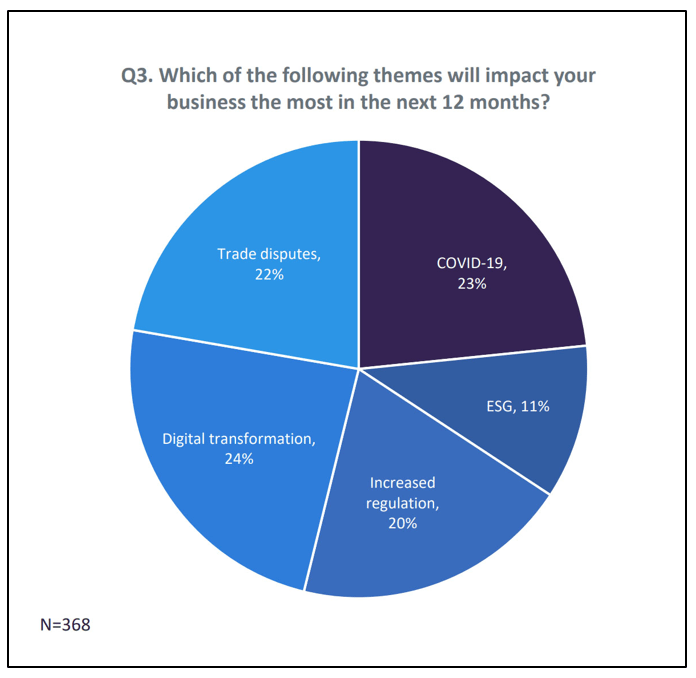
(Source: GlobalData Thematic Intelligence ESG Sentiment Poll Q3 2022)
However, one factor to consider is that the majority of regulatory changes impacting businesses are either directly or tangentially linked to ESG, especially sustainability. Similarly, digital transformation efforts are very often linked to the need to be more efficient – a process that will have sustainability and bottom-line benefits. A key conclusion to draw, therefore, is that thinking about sustainability will help enterprises with the immediate challenges they face as well as positioning them to accommodate legally mandated sustainability reporting and improvement targets that are on the horizon in most countries.
The question then becomes: ‘How can this be achieved?’ especially when budgets are under pressure. There is not one simple solution that can bring results, but deploying an ecosystem of integrated technologies will take enterprises a long way – and may deliver return of investment benefits faster than enterprises think.
IoT technology lies at the heart of more advanced efficiency solutions. To achieve efficiency, businesses need to know what is happening across their business and what impact policy changes are having. IoT sensor technology offers the opportunity to monitor machinery, equipment, and even workers. Without this data, it will also be next to impossible for enterprises to fulfill regulatory and shareholder and customer demanded data on sustainability.
But enterprises should be aware that merely collecting the data on its own is not enough to derive maximum value. With so much data, the biggest challenge can be merely understanding what it means. This is where AI and edge compute come into play. AI technology will help businesses to process the data and establish trends and patterns. The more AI is exposed to data, the more it will learn and ultimately be able to make suggestions to benefit the business. This can be, at the practical end, predictive maintenance/accident prevention, or more strategically AI can help to predict, which changes to working practices that will deliver the most efficiency benefits and sustainability benefits.
The role of edge compute in this process is to ensure that the AI is close enough to the data to deliver real-time benefits. This is particularly true in industrial scenarios (e.g., manufacturing plants or logistic sites). Edge infrastructure can also help to move legacy applications out of inefficient private data centers and into more sustainable technology environments that can also support a low-latency environment acceptable to application designed to be run across LANs rather than WANs.
For the most advanced scenarios in large sites or heavily industrialized locations, private wireless should also be considered. The technology can sit alongside existing wireless technology such as WiFi and form part of a gradual transformation process rather than being part of a rip-and-replace process. GlobalData’s research also suggests that private wireless, in the right environments, can offer a quick return on investment through efficiency benefits.
Yes, AI can certainly help businesses to process data and establish trends and patterns in this data.